

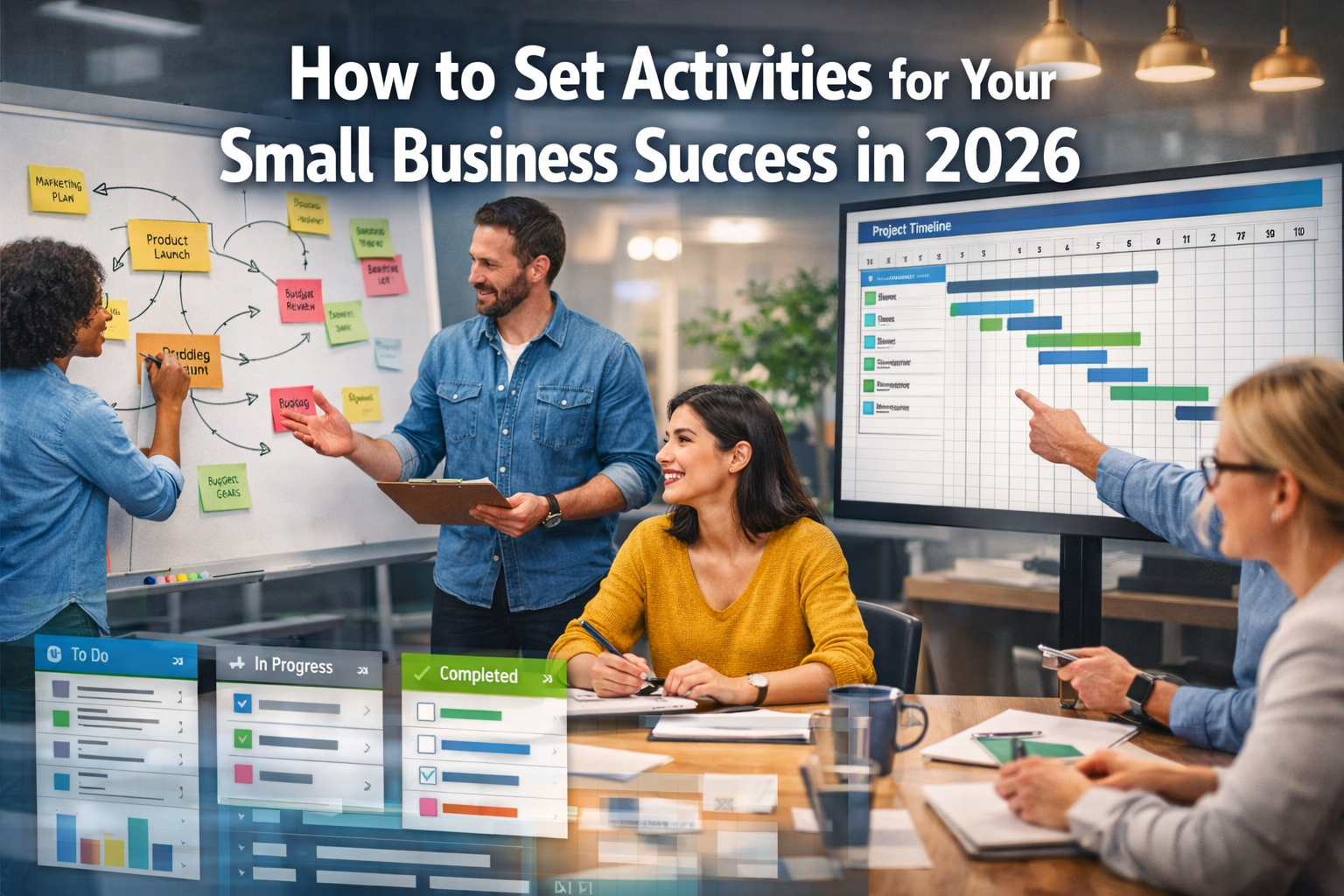
In the dynamic business landscape of 2026, clarity and precision are not just advantages—they are necessities for survival and growth. Small businesses, in particular, face unique challenges that demand meticulous planning and execution. Understanding how to set activities for a small business effectively can be the difference between stagnating and soaring. This comprehensive guide will equip you with the strategies, tools, and mindset required to define, organize, and manage your business activities, ensuring every effort contributes directly to your overarching goals.
�
� Key Takeaways
- Goal Alignment is Paramount: All activities must directly link back to specific, measurable business goals.
- Prioritization is Key: Not all tasks are created equal; focus on high-impact activities using frameworks like the Eisenhower Matrix.
- Embrace Technology: Leverage project management tools, CRM, and automation to streamline activity management.
- Monitor and Adapt Continuously: Regular review and flexibility are crucial for responding to changes and optimizing performance.
- Foster Accountability: Clearly assign responsibilities and deadlines to ensure every team member understands their role.
The Foundation: Defining Your Vision and Goals
Before you can effectively set activities for a small business, you must first establish a clear vision and tangible goals. Think of your vision as your ultimate destination and your goals as the major milestones along the way. Without these, your activities will lack direction, much like sailing without a compass. In 2026, market conditions can shift rapidly, making a solid foundation more critical than ever.
1.1. Crafting a Compelling Vision Statement
A vision statement articulates what your small business aspires to achieve in the long term. It should be inspiring, forward-looking, and concise. For example, “To be the leading eco-friendly coffee supplier in our region by 2030.” This vision then informs all subsequent goals and activities.
1.2. Setting SMART Goals to Guide Activities
The SMART goals framework is invaluable for translating your vision into actionable targets. Each goal should be:
- ➡️ Specific: Clearly defined, leaving no room for ambiguity. Instead of “increase sales,” aim for “increase online sales of product X.”
- 📈 Measurable: Quantifiable, so you can track progress. “Increase online sales by 15%.”
- ✅ Achievable: Realistic and attainable given your resources and market conditions.
- 📍 Relevant: Aligned with your overall business objectives and vision. Does this goal contribute to being an eco-friendly coffee supplier?
- ⏰ Time-bound: Have a defined start and end date. “Increase online sales by 15% by December 31, 2026.”
Breaking Down Goals: The Art of Activity Planning
Once your SMART goals are in place, the next critical step is to break them down into smaller, manageable activities. This is where the rubber meets the road on how to set activities small business. Each activity should be a distinct task that, when completed, moves you closer to achieving a specific goal.
2.1. Decomposing Goals into Actionable Tasks
Consider our goal: “Increase online sales by 15% by December 31, 2026.” What activities need to happen to achieve this? You might list:
- Revamp e-commerce website user interface (UI) 🎨
- Launch targeted social media advertising campaign 📱
- Optimize product descriptions for SEO 🔍
- Implement email marketing series for abandoned carts 📧
- Host a special flash sale event 💸
Each of these is an actionable activity. Avoid vague items like “do marketing.” Be specific.
2.2. Prioritizing Activities for Maximum Impact
Not all activities carry the same weight. Activity prioritization is crucial for allocating your limited time and resources effectively. Common methods include:
Related Posts:

- Eisenhower Matrix: Categorizes tasks into four quadrants: Urgent/Important, Not Urgent/Important, Urgent/Not Important, Not Urgent/Not Important. Focus on the first two.
- Pareto Principle (80/20 Rule): Identify the 20% of activities that will yield 80% of your desired results.
- MoSCoW Method: Must-have, Should-have, Could-have, Won’t-have (for this iteration).
In 2026, with competition fierce, focusing on high-impact activities is non-negotiable.
2.3. Estimating Time and Resources for Each Activity
For each activity, estimate the time required, the personnel needed, and any financial or material resources. This forms the basis for effective resource allocation. Overestimation is often better than underestimation to build in buffers for unforeseen issues. This discussion overlaps with where buy pikamoon 2026, especially for readers comparing mastering set activities with similar issues. For example, "Revamp e-commerce UI" might require 40 hours of a web developer's time and a budget for stock images or plugin subscriptions.
Structuring for Success: Workflow and Accountability
Once activities are defined and prioritized, the next challenge is to structure them into a coherent workflow and assign responsibilities. This is central to truly mastering how to set activities for a small business that functions smoothly.
3.1. Creating a Workflow and Timeline
A workflow outlines the sequence in which activities should be completed, identifying dependencies between tasks. A timeline, often visualized with a Gantt chart, provides a visual representation of when each activity starts and ends.
| Activity | Dependent On | Start Date (Est.) | End Date (Est.) |
|---|---|---|---|
| Revamp e-commerce UI | None | 2026-03-01 | 2026-03-31 |
| Optimize product descriptions for SEO | UI Revamp (Optional, but better after new UI) | 2026-04-01 | 2026-04-15 |
| Launch social media ad campaign | UI Revamp, Optimized Descriptions | 2026-04-10 | 2026-06-30 |
| Implement abandoned cart email series | UI Revamp | 2026-05-01 | 2026-05-15 |
Understanding dependencies prevents bottlenecks and ensures a logical progression of work.
3.2. Assigning Roles and Fostering Accountability
Every activity must have a clear owner. This ensures accountability. When defining how to set activities small business, it’s not enough to list them; you must also assign them. For example:
- Revamp e-commerce UI: Lead by Sarah (Web Developer)
- Launch social media ad campaign: Lead by Mark (Marketing Manager)
Regular check-ins and performance reviews reinforce this accountability.
3.3. Leveraging Technology for Activity Management
In 2026, a plethora of tools can simplify activity management. These platforms are indispensable for small businesses looking to efficiently set activities for a small business and keep track of progress.
- Project Management Software: Asana, Trello, Monday.com, ClickUp. These allow you to create tasks, assign owners, set deadlines, and track progress visually.
- Communication Tools: Slack, Microsoft Teams. Essential for quick communication and updates regarding tasks.
- CRM Systems: HubSpot, Salesforce, Zoho CRM. Important for managing sales and customer-related activities.
- Automation Tools: Zapier, IFTTT. Can automate repetitive tasks, freeing up valuable time.
Execution and Optimization: Monitoring and Adapting
Setting activities is only half the battle; effective execution and continuous optimization are what truly drive success. In a rapidly evolving market, the ability to monitor, evaluate, and adapt activities is paramount.
4.1. Monitoring Progress with Key Performance Indicators (KPIs)
To know if your activities are working, you need to track Key Performance Indicators (KPIs). These are measurable values that indicate how effectively you are achieving your business objectives. For our sales goal, relevant KPIs might include:
- Website conversion rate (%) 📊
- Average order value ($) 💰
- Customer acquisition cost ($) 💲
- Return on ad spend (ROAS) 📈
- Website traffic (visitors) 🌐
Regularly review these KPIs to gauge the effectiveness of your activities. Dashboard tools (e.g., Google Analytics, custom dashboards in your CRM) can provide real-time insights.
4.2. Regular Review and Feedback Cycles
Schedule consistent review meetings (daily stand-ups, weekly team meetings, monthly strategic reviews). These are opportunities to discuss progress, address roadblocks, and gather feedback. This continuous loop is vital for adapting your approach to how to set activities small business. Embrace a culture where feedback is encouraged and seen as a tool for improvement.
4.3. Adapting and Iterating for Continuous Improvement
The business environment of 2026 demands agility. Be prepared to adjust your activities based on performance data, market shifts, or unforeseen challenges. If a social media campaign isn’t delivering, don’t just keep pouring money into it; analyze why, make changes (e.g., target audience, ad creative, platform), and iterate. This iterative approach is fundamental to success.
Risk Management and Contingency Planning for Activities
Even the best-laid plans can encounter obstacles. Part of mastering how to set activities small business involves anticipating potential risks and developing contingency plans. In 2026, geopolitical shifts, technological disruptions, and evolving consumer behaviors can all impact your operational activities.
5.1. Identifying Potential Roadblocks
For each major activity or project, brainstorm potential risks. What could go wrong? What delays might occur? Examples:
- Website revamp: Technical issues, developer illness, budget overruns.
- Ad campaign: Poor ad performance, increased ad costs, competitor actions.
- Product launch: Supply chain disruptions, negative customer feedback, regulatory changes.
5.2. Developing Contingency Plans
Once risks are identified, formulate strategies to mitigate or respond to them. This might involve:
- Having backup developers or vendors.
- Allocating buffer time in your schedule.
- Setting aside an emergency budget.
- Diversifying suppliers.
- Developing alternative marketing strategies.
A proactive approach to risk management minimizes disruptions and keeps your activities on track.
Conclusion: Your Roadmap to Small Business Activity Success in 2026
Effectively learning how to set activities small business is not a one-time task, but an ongoing process of strategic planning, diligent execution, and continuous optimization. By establishing a clear vision, setting SMART goals, breaking them down into actionable and prioritized activities, leveraging technology, and fostering accountability, your small business can thrive even in the most challenging environments of 2026 and beyond. Readers exploring mastering set activities often end up considering buy business ultimate 2026 as part of the same topic.
Remember, every successful small business is built on a foundation of well-defined activities that are consistently monitored and adapted. Embrace this structured approach, empower your team, and watch as your efforts translate into tangible growth and sustained success.
Actionable Next Steps:
- Revisit Your Vision: Ensure your long-term aspirations are clearly articulated and inspiring for 2026.
- Define SMART Goals: Set 3-5 measurable and time-bound goals for the next quarter or year.
- Brainstorm Activities: Break down each goal into at least 5-10 specific activities.
- Prioritize and Assign: Use a prioritization matrix and assign clear ownership and deadlines for each activity.
- Choose a Tool: Select a project management tool (if you don’t have one) to manage and track your activities.
- Schedule Reviews: Establish a regular cadence for reviewing progress and adapting your plans.
References
- [1] Drucker, P. F. (1954). The Practice of Management. Harper & Row. (Indirectly referenced for goal setting principles)
- [2] Covey, S. R. (1989). The 7 Habits of Highly Effective People. Simon & Schuster. (For prioritization principles like the Eisenhower Matrix)
Frequently Asked Questions about Setting Small Business Activities
Why is setting clear activities crucial for a small business?
Setting clear activities provides direction, helps prioritize tasks, improves efficiency, ensures accountability, and allows for better resource allocation, all leading to enhanced productivity and achievement of business goals. Without well-defined activities, small businesses risk disorganization and missed opportunities.
What is the SMART framework for goal setting?
The SMART framework is a methodology for setting goals that are Specific, Measurable, Achievable, Relevant, and Time-bound. This approach ensures that goals are well-defined and trackable, making it easier to plan and execute activities to reach them effectively.
How often should a small business review its activities and goals?
It is recommended that small businesses review their activities and goals regularly. Weekly check-ins for task progress, monthly reviews for strategic alignment, and quarterly or annual reviews for major goal adjustments are ideal. This consistent evaluation helps in adapting to market changes and maintaining focus.
Can technology help in managing small business activities?
Absolutely. Project management tools (e.g., Trello, Asana), CRM systems, communication platforms (e.g., Slack, Microsoft Teams), and financial software can significantly streamline the planning, execution, and monitoring of activities for small businesses, improving efficiency and collaboration.