

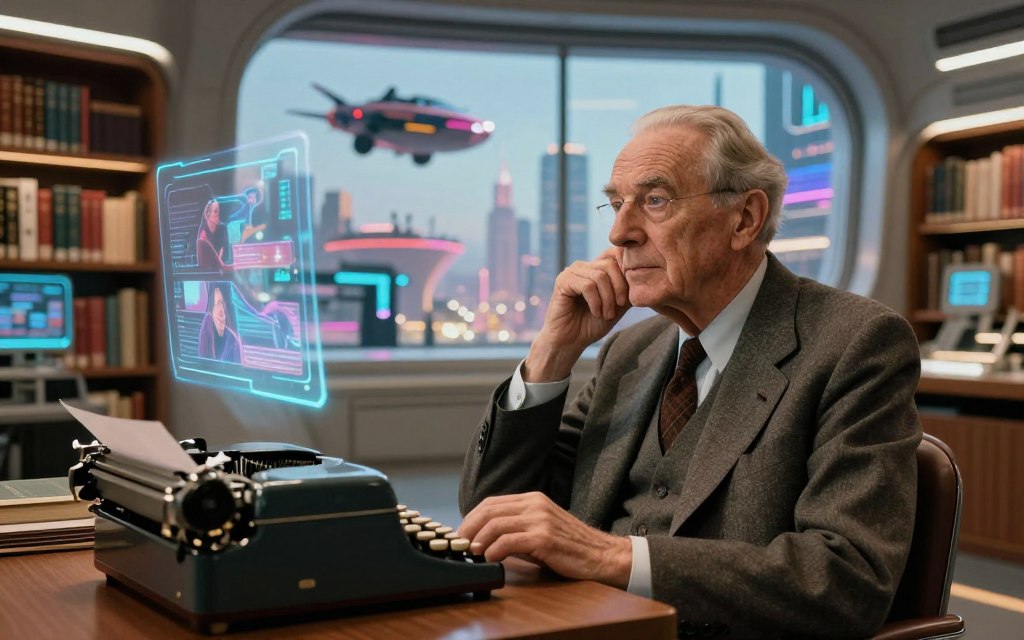
How did Ray Bradbury feel about technology? His complex view warns that rapid change can cause emotional disconnection. Ray Bradbury and technology offer a useful lens for understanding smartphones, streaming platforms, and artificial intelligence. But what insights can we glean from his work regarding our modern landscape?
Ray Bradbury books such as Fahrenheit 451, The Pedestrian, and The Veldt explore passive entertainment and censorship. Rather than rejecting innovation, Bradbury asks us to consider how our choices affect empathy and curiosity. His cautionary tales show a delicate balance between embracing invention and preserving our humanity.
This article examines Bradbury’s perspective on technology. It shows why his themes still matter as virtual reality and social media shape our lives. Exploration and imagination appear as positive forces in technology in science fiction, supporting a balanced analysis of his literary contributions.
Key Takeaways
- Bradbury’s works reflect concerns about emotional disconnection due to technology.
- He warns against passive entertainment and censorship in society.
- Exploration and imagination are portrayed as positive forces in his writings.
- His themes remain relevant in today’s digital landscape.
- Literary analysis reveals a nuanced view of innovation and humanity.
The Visionary Mind of Ray Bradbury: Setting the Stage
This Ray Bradbury biography traces his early life and growing love of literature. Ray Bradbury literary influences and self-education shaped his early voice. Born in 1920 in Waukegan, Illinois, he spent countless hours in libraries, shaping his voice as a science fiction author.
Ray Bradbury literary influences included Edgar Allan Poe, H.G. Wells, and Jules Verne. Their imaginative stories fueled his passion for technology’s possibilities and human behavior. He once said:
“You must stay drunk on writing so reality cannot destroy you.”
This quote shows Bradbury’s belief that imagination can shelter people from harsh reality.
Within American science fiction, Bradbury crossed traditional genre boundaries. His stories blended literary fiction, fantasy, and social criticism. Unlike many contemporaries, he made fewer precise predictions about the future and explored technology’s emotional and moral effects.
His stories often use futuristic inventions as symbols of loneliness, conformity, and moral choice. Through this lens, the Bradbury imagination reveals deep insights into human nature and invites readers to reflect on relationships with technology.
Related Posts:






How Did Ray Bradbury Feel About Technology: His Core Philosophy
Ray Bradbury’s view of technology was complex and thoughtful, shaped by its effects on society. He saw technological progress as both helpful and dangerous to human life. That balance defines the Ray Bradbury technology philosophy: he accepted innovation but warned about its risks.
The Dual Nature of Technological Progress
Bradbury saw technology as a powerful tool for exploration and knowledge. It can broaden our horizons and improve daily life. Yet he knew it could cause passivity, emotional avoidance, and dangerous conformity, as he famously stated:
“We stand on the brink of a great new age, but we must choose wisely how we use the tools we create.”
Defining Bradbury’s Technological Skepticism
Bradbury’s technology skepticism grew from his fear that convenience could replace critical judgment. He warned that entertainment might overshadow real participation and encourage unthinking dependence on machines. This caution was not outright condemnation; his writings urged technology to serve humanity, not the other way around.
Technology as a Mirror of Human Nature
One of Bradbury’s profound insights was that technology mirrors existing human tendencies, rather than creating new problems. His stories show how technology and human nature shape technological outcomes. Privacy loss and digital distraction still echo his warnings about dependence on automated systems.
He believed technology could improve life while revealing human flaws and vulnerabilities.
Today, his philosophy still matters in debates about algorithmic personalization and surveillance. His strongest criticism focused on unthinking dependence on technology, urging critical use of our tools. This view leads to deeper study of Fahrenheit 451, where technological reliance has stark consequences.
Fahrenheit 451: Technology as a Tool of Destruction
In Fahrenheit 451, Ray Bradbury shows how technology can damage society. The novel presents a future shaped by censorship and technology, where human life grows weaker and ignorance spreads.
The Mechanical Hound and the Surveillance State
The Mechanical Hound symbolizes the dehumanizing side of technological enforcement. This robot is programmed to hunt and intimidate dissenters in a surveillance state where monitoring is everywhere. It raises questions about public safety and civil liberties, echoing modern debates about facial recognition and predictive policing.
Wall Screens and the Death of Literature
Wall screens in Fahrenheit 451 represent immersive entertainment that replaces meaningful conversation and reflection. They create false connection and contribute to society’s intellectual decline. The pressure to enjoy shallow entertainment encourages people to avoid challenging ideas, showing how technology can foster cultural passivity.
Seashell Radios and Constant Distraction
Seashell radios offer an early picture of portable media that fills silence with noise and blocks introspection. This constant distraction mirrors today’s world of notifications and short-form content. Like Seashell radios, modern earbuds and personalized feeds can block deep thought and reflection.
Ultimately, Fahrenheit 451 is more than books versus machines; it examines censorship and technology and human surrender to distraction. Bradbury’s work warns that unchecked technological advancement can erode critical thinking and cultural engagement.
The Pedestrian: Surveillance and Isolation in Modern Cities
Ray Bradbury’s short story, The Pedestrian, presents a chilling vision of technology controlling behavior and social rules. Leonard Mead walks empty streets, revealing urban surveillance, social isolation, and technology’s power over daily life.
Leonard Mead’s Solitary Walks
Leonard Mead stands apart in his dystopian world. Each night, he takes a solitary walk, seeking contact with the physical world others have abandoned. His quiet act contrasts with residents glued to screens, while his noncriminal choice exposes society’s deep disconnection.
Mead’s solitary walks rebel against conformity. Because walking has become obsolete, his choice defends human independence, yet society treats it with suspicion. As he studies his surroundings, technology has transformed social interaction into a mere shadow of its former self.
The Automated Police Cruiser
The automated police cruiser deepens Bradbury’s critique of urban surveillance. Its cold efficiency favors control over understanding and replaces human judgment with programmed assumptions, making walking seem defiant.
In this setting, the automated police cruiser represents fears of a future ruled by technology. It shows declining freedom and a surveillance state that tracks every movement, raising questions about technology and social behavior.
Bradbury’s story links social isolation and technology to urban emptiness. As digital connections grow, pressure to conform grows too. Automated monitoring and location tracking echo current concerns about balancing innovation with human connection.
Ultimately, The Pedestrian praises walking, observation, and direct contact with the world. Bradbury asks us to value physical presence in a digital age. As we live with technology, his ideas remain relevant and urge us to reclaim autonomy in a monitored society.

The Veldt: Virtual Reality and Family Dynamics
In ‘The Veldt,’ Ray Bradbury examines technology and family life. The story is an important example of virtual reality in literature and shows how immersive technology can weaken family bonds.
The nursery in ‘The Veldt’ acts as a technological crutch for the children. This automated space answers their thoughts and desires, giving them instant pleasure. It takes over parental duties, while George and Lydia Hadley grow distant from children relying on it for emotional comfort.
The Nursery as a Technological Crutch
The nursery creates lifelike scenes, blurring the line between reality and imagination. It follows the children’s wishes and builds a virtual African veldt, but this immersion separates them from their parents.
Children’s Attachment to Virtual Worlds
Bradbury shows that the children’s virtual world can displace real emotions. Repeated nursery visits make the digital realm more appealing than real contact, raising concerns about children and screen time, social growth, and emotional health.
The Dark Side of Immersive Technology
The story reveals the dark side of immersive technology. Systems that satisfy every desire may limit empathy and responsibility. Bradbury warns that artificial interactions should not replace real relationships; imagination must not weaken human connection.
Bradbury’s cautionary tale still shapes debates about gaming, virtual worlds, and artificial intelligence’s influence on children. It links technology and parenting, reminding parents to guide children’s media use rather than blame children alone.
Bradbury’s Warnings About Television and Mass Media
Ray Bradbury television criticism offers modern audiences a warning about television and mass media. “Dandelion Wine” celebrates sensory experiences, local communities, and rich memories, unlike his darker works. It stresses active participation in life, which Bradbury feared mass media might overshadow.
Bradbury believed excessive media consumption could cause intellectual decline. He warned passive audiences might lose critical thinking and ignore diverse perspectives. They might accept packaged opinions without question, while streaming services and viral content encourage this pattern.
Comparing Bradbury’s television culture with today’s digital landscape reveals a troubling trend. Algorithms and nonstop news can narrow attention and limit deep thinking. His criticism does not reject all media; storytelling and communication can enrich television and society when they supplement, not replace, meaningful interaction.
| Aspect | Bradbury’s Perspective | Modern Comparison |
|---|---|---|
| Media Consumption | Encourages active engagement | Often passive and superficial |
| Intellectual Engagement | Fosters critical thinking | May lead to intellectual decline |
| Community Interaction | Values local connections | Can promote isolation |
Ultimately, Bradbury’s warnings show that our media consumption choices matter. We must balance modern technology’s convenience with intellectual responsibility and genuine human connection.
The Optimistic Side: Technology as a Force for Good
Ray Bradbury optimism included more than warnings about technology. He saw technology as a powerful tool that could inspire and uplift humanity. His writings celebrate space exploration and human achievement.
Space Exploration and Human Achievement
In Bradbury’s works, space exploration symbolizes human curiosity and ambition. It shows our drive to cross familiar boundaries and discover the unknown. This journey seeks knowledge and understanding, while imagination and purpose turn it into human achievement.
His astronauts and explorers are brave, determined characters. They reflect our shared wish to encounter something larger than ourselves. Their wonder reminds us that ethical technology can lead to remarkable achievements.
The Martian Chronicles and Technological Hope
In “The Martian Chronicles,” Bradbury explores the dual nature of technological expansion. The stories celebrate scientific discovery and human adaptability, yet they also warn readers. They show how colonial arrogance and environmental destruction can follow technological progress.
Bradbury portrays Mars as a new frontier filled with hope. It shows what humanity can achieve with responsible technology. His stories encourage readers to reflect on how capability without wisdom can repeat old injustices in new settings.
Ultimately, Bradbury’s optimism rests on technology’s power to foster imagination, cooperation, humility, and responsibility. His science fiction hope challenges us to use technology for good, so exploration strengthens rather than diminishes our humanity.
Bradbury’s Predictions That Came True
Ray Bradbury studied technology and human behavior with striking insight. His stories explored changes that now shape our digital lives. Ray Bradbury predictions include flat screen TVs and social media echo chambers.
Flat Screen TVs and Wall-Mounted Displays
In Fahrenheit 451, Bradbury showed wall-mounted screens as the main source of entertainment. Today, flat screen TVs and home entertainment systems fill many living spaces. These wall-mounted displays have become architectural features, like the fictional “parlor walls” in Bradbury’s narrative.
Earbuds, Streaming, and Personalized Media
Bradbury’s Seashell radios resemble today’s earbuds and streaming services. Personalized media provides a constant flow of stimulation. People use smartphones and podcasts for tailored content, replacing shared listening and echoing his concerns about isolation in crowded places.
Social Media Echo Chambers and Virtual Reality
Bradbury’s themes of manufactured reality and selective information appear in today’s social media echo chambers. They strengthen existing beliefs, cause emotional isolation, and create closed digital worlds. His virtual reality predictions match warnings about surveillance and technology’s impact on human relationships.
“We stand on the brink of a new world, where technology shapes our lives in ways we cannot yet fully comprehend.”
| Bradbury’s Predictions | Modern Parallels | Implications |
|---|---|---|
| Wall-Mounted Displays | Flat Screen TVs | Centralized entertainment |
| Seashell Radios | Earbuds and Streaming | Isolation through personalization |
| Manufactured Reality | Social Media Echo Chambers | Reinforcement of biases |
Though Bradbury may seem like a technology prophet, he was a keen observer of human behavior and social trends. His technology insights warn about modern life’s complexity rather than predict exact inventions.
Lessons from Bradbury for Today’s Digital Age
Ray Bradbury’s works still matter in our digital age. His ideas about technology offer digital age lessons for our connected world. Smartphones, social media, and artificial intelligence can shape relationships and critical thinking online.
Balancing Innovation with Human Connection
When technology simulates connection, we should ask whether devices strengthen or weaken real relationships. Intentional screen boundaries help protect meaningful interactions. Bradbury’s focus on human connection and technology urges us to join local communities and value face-to-face talks.
As technology advances, we should ask whether each innovation brings people closer or distracts us from one another. By choosing when and how to use technology, we can make it a tool for connection, not a barrier.
Preserving Critical Thinking in a Digital World
In an age of information overload, critical thinking matters more than ever. Bradbury’s warnings about media use urge us to question sources and notice algorithms shaping our online experiences. Identifying emotional manipulation and checking claims help us navigate the digital world.
Rejecting information that only confirms our beliefs supports digital literacy. We should not reject technology; we should practice responsible technology use. Ray Bradbury relevance means keeping control, choosing when and why to use devices rather than letting platforms direct our attention.
These principles can create a balanced relationship with technology, supporting critical thinking and real human connection. Bradbury’s insights remain vital as we face digital-age challenges and protect our humanity from digital noise.
For more insight into Ray Bradbury’s themes and their modern meaning, read this article.
Conclusion
How did Ray Bradbury feel about technology? His view explains Fahrenheit 451 relevance. He saw technology as complex, not inherently evil, but dangerous without reflection and empathy. In Fahrenheit 451, surveillance can suppress individuality, while immersive entertainment can replace meaningful relationships.
The Ray Bradbury legacy urges us to examine our relationship with technology and humanity. He believed technology can distract, yet it can inspire exploration and creativity. Its future depends on the values and choices of people who create and regulate it, not machines alone.
As we navigate an increasingly digital world, Bradbury’s cautionary tales urge us to stay curious, compassionate, and engaged. The challenge is keeping technology and humanity in balance, so humanity prevails. His literary legacy guides us to value meaningful connections and critical thinking amid screens and automation.